Choose your consultation format
Which country are you planning to move?
Choose your consultation format
Choose your consultation format


en


•
9 min
Health card, school, residence permit: in Spain, most key procedures start with one document. Here's how empadronamiento works and what you need to register in 2026.
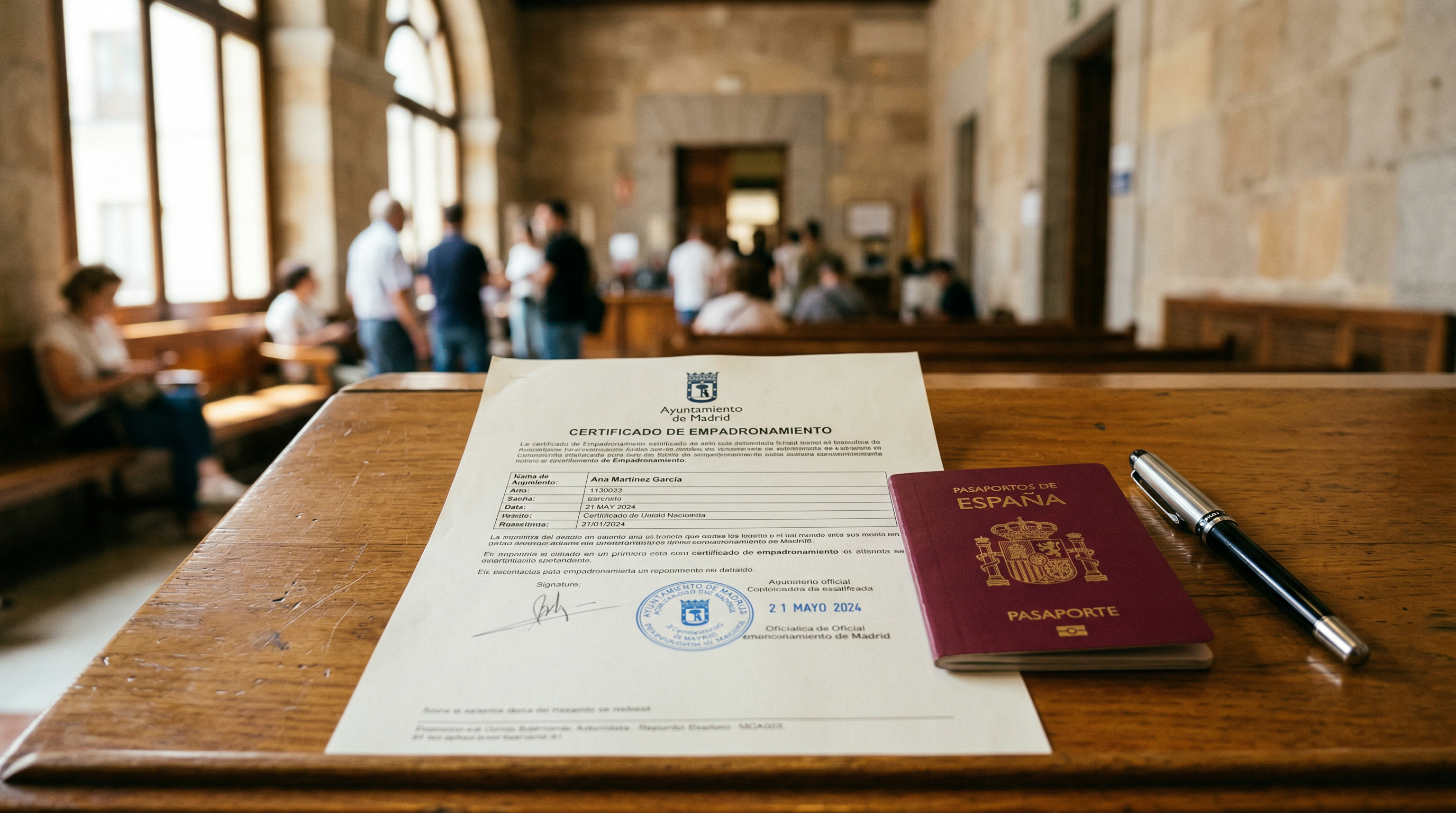
In short: empadronamiento is registration on the padrón, the list of residents kept by your town hall (ayuntamiento). It proves where you live; it is not a residence permit and does not let you work.
You've arrived in Spain, got a place to live, and you're trying to sort out your health card, residence permit, school enrollment for the kids. But most of these procedures will hit the same wall: you need to be on the padrón first.
Empadronamiento is being registered at your local town hall (ayuntamiento), and it's how Spain officially knows where you're living. Your name and address go on the register, and from then on, the Spanish system starts recognizing you as a local resident.
Without being on the padrón, you can't get a health card. Without it, your children can't be enrolled in public school. For most residence types, padrón is required at the fingerprinting stage for your TIE card. Digital nomads, startup founders, and highly qualified professionals under Ley 14/2013 are exempt at first fingerprinting in most cities (Madrid, Barcelona, Bilbao, Alicante, and others), though some police stations ask for it anyway. Valencia requires it.
Spanish law says everyone living in Spain must be on the padrón. Citizens, EU people, non-EU residents, and even those without a visa or permit. Your immigration situation isn't relevant; if you're sleeping at an address in Spain, that address ought to be on the padrón.
A lot of people new to the country get this wrong. Empadronamiento isn't a residence permit. It doesn't give you legal status. It doesn't let you work. It's a census record: proof that a person lives at a particular address.
But it's needed for most key procedures. Think of it as the foundation layer of Spanish bureaucracy. A lot doesn't get built without it.
The padrón certificate (certificado de empadronamiento) is the document you'll hand over more than any other in Spain. Here's where you'll need it:
| Procedure | Why padrón is required |
|---|---|
| Public healthcare (tarjeta sanitaria) | Proves you live in the catchment area of a health center |
| School enrollment | Required for public and state-subsidized (concertado) schools. Private schools don't require padrón |
| TIE card (foreigner's ID) | Required for most visa types at fingerprinting. Ley 14/2013 holders may be exempt at first fingerprinting |
| NIE renewal / Residence permits | Initial NIE doesn't require padrón, but renewals and residency continuity proof typically do |
| Spanish citizenship | Proves legal residence (1, 2, 5, or 10 years depending on nationality/status) |
| Banking & Utilities | Address proof for opening accounts, signing electricity, water, or internet contracts |
| Buying a car or property | Registration requires proof of address |
| Arraigo (regularization) | Proves continuous presence in Spain (2 years after May 2025 reform) |
The padrón also establishes a timeline. Spanish authorities use it to work out how long you've been living in the country. For citizenship applicants, those years on the register are non-negotiable evidence.
Requirements vary by municipality (every ayuntamiento has its own quirks), but the standard list looks like this:
For everyone:
Proof of address (1 of these):
If the rental agreement isn't in your name:
Registering children:
Important: take originals and photocopies. Town halls in Spain love photocopies. Two copies of everything is a good idea.
1. Book an appointment (cita previa)
Almost all town halls require an appointment. Walk-ins are rare in cities, and are becoming less common in smaller towns too.
Search online for "cita previa empadronamiento + your town name". The appointment system is usually on the ayuntamiento's website. In Madrid, it's via the Sede Electrónica; in Barcelona, through the Ajuntament portal. Smaller towns might use a phone booking system.
Appointment availability depends on where you live. In Madrid and Barcelona, expect waits of 2 to 4 weeks. Smaller cities like Granada, Málaga, or Valencia tend to be faster (a few days to 2 weeks).
2. Gather your documents
Print everything. Fill out the application form beforehand if it's available online. Double-check that your rental contract matches the address you're registering at. Sounds obvious, but address mismatches cause rejections.
3. Go to your town hall
Arrive on time. Bring all originals and copies. If your paperwork is right, the process itself should take 15 to 30 minutes.
The official will check your documents, put your details into the system, and give you a volante de empadronamiento there and then. This is the basic registration slip, and it's free.
4. Get the official certificate (if needed)
The volante is good enough for most things. But for official processes (residence permits, citizenship applications, court filings), you'll need the certificado de empadronamiento. This is the stamped, official version.
Some town halls issue it on the same day. Others take 3 to 5 working days. It's free in most cities (including Madrid and Barcelona). A few smaller towns charge a small fee, but rarely more than a couple of euros.
In the bigger cities (Madrid, Barcelona, Valencia, and a few others), you can register online via their websites.
You'll need:
Getting Cl@ve used to require an in-person visit. As of 2025, you can also register through video identification, a video call with a public employee, an invitation letter, or by using an existing digital certificate.
If you've only arrived in Spain and don't have any of these, online registration won't work for your first empadronamiento. It's more useful when you need to change your address later.
For most people who've newly arrived, going to the ayuntamiento in person is the best thing to do.
Not everyone has to renew it. Here's how it breaks down:
Resident typeRenewal requirementSpanish citizensNo renewal neededEU nationals with permanent residencyMay be asked to confirm after 5 years of inactivity on the registerNon-EU nationals with permanent residencyMay be asked to confirm after 5 years of inactivity (same as EU nationals)Non-EU nationals with temporary residencyMust renew every 2 yearsNon-EU nationals without residencyMust renew every 2 years
If you're a non-EU citizen on a temporary visa (digital nomad visa, student visa, work visa), mark your calendar. Missing the 2-year renewal means automatic removal from the padrón. That can mess up your residence timeline and cause problems with permit renewals.
The renewal process is the same as the original registration: book an appointment, bring your documents, confirm your address.
One more thing: the physical certificado de empadronamiento expires after 90 days. The registration itself stays active, but if someone asks for a "recent" certificate, you'll need to request a fresh one.

15-minute
Book a free consultation
Short consultation is best option to find your way to move or to get an introduction to different types of visas and residence permits in Spain.
Your apartment is registered as commercial space. This happens more often than you'd expect. If the catastro (land registry) classifies your unit as an office or commercial property, the town hall may create practical obstacles to registering you there.
Legally, they can't refuse registration at an address where you live (INE resolutions are clear on this), but the process can take longer if the classification doesn't match. Ask your landlord to verify the property classification before signing to avoid delays.
The landlord won't authorize your registration. Some landlords resist padrón registration because they're renting informally or underreporting income. Spanish law gives you the right to register at any address where you live. If the landlord refuses, you can ask the town hall to send an inspector to verify your residence (though this takes time).
Appointment slots are fully booked. In Madrid and Barcelona, this is chronic. Check the booking portal early in the morning (new slots often open at midnight or 8:00 AM). Some people check daily for cancellations. Third-party appointment alert services exist, though we can't vouch for specific ones.
Your documents are in a foreign language. Town halls accept Spanish-language documents. If your rental contract or utility bill is in another language, you may need a sworn translation (traducción jurada). This applies to birth certificates and marriage certificates too.
Once you're on the padrón, you can start dealing with the rest of Spanish bureaucracy:
If you move to a different town or city within Spain, you'll have to register again at the new ayuntamiento. The old registration will be cancelled automatically when the new one is processed. Do this within 30 days of moving.
The padrón is the starting point for most procedures in Spain: from your health card to residence permits and citizenship. Get it sorted in your first week, and everything else gets easier.

Assistance packages
Immigrate to Spain with us without mistakes and stress 🇪🇸
We will guide you step-by-step to avoid making mistakes
Written by